The Job Costing Problem
Ask most contractors how profitable their last project was, and you'll get a pause. Maybe a rough estimate. Possibly a guess based on whether it "felt" profitable. Precise numbers? Those come months later, if at all, buried in year-end financial statements.
This information gap is costing the industry billions. According to research, estimation mistakes alone cost an average of 5% of total project budgets. But the bigger cost is in the projects bid too low (destroying margins) or too high (losing work unnecessarily) because contractors don't have reliable profitability data from past jobs.
Real-time job costing—knowing exactly where you stand on every project at any moment—isn't a nice-to-have anymore. It's a competitive necessity.
Why Traditional Job Costing Fails
The Data Entry Bottleneck
Traditional job costing depends on people entering data: coding invoices, allocating labor hours, categorizing expenses. This manual process is:
Slow: Invoices sit in a pile. Time cards get entered weekly. Costs are recorded days or weeks after they're incurred.
Error-Prone: Wrong job codes, transposed numbers, forgotten entries—manual data entry has error rates of 1-3%, which compounds across thousands of transactions.
Incomplete: Some costs never get captured. That material run to the hardware store on a personal card. The overtime approved verbally. The equipment repair done in the field.
The Timing Problem
Even with perfect data entry, traditional job costing provides rearview mirror information. You discover you're over budget in August for costs incurred in June. By then, the opportunity to take corrective action has passed.
The Granularity Problem
Many contractors track costs at the project level only. They know they spent $500,000 on the Jones project, but not how that breaks down: - By phase (foundation vs. framing vs. finish) - By cost type (labor vs. material vs. equipment) - By comparison to estimate
Without granular data, you can't identify where profit is made and lost.
The Analysis Gap
Raw cost data is useless without analysis. What percentage of material costs came from plan changes? How did actual labor productivity compare to bid assumptions? Traditional systems capture data but don't answer questions.
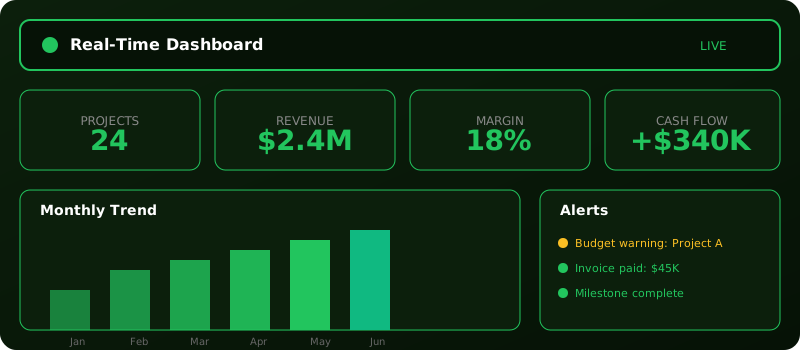
Modern Job Costing: The Complete Picture
Effective job costing in 2025 requires a fundamentally different approach—one built on automation, real-time data, and intelligent analysis.
Real-Time Cost Capture
Every cost should be recorded as it's incurred, automatically when possible:
Labor: Time tracking systems capture hours by job, phase, and cost code at the point of work. No end-of-week time card entry from memory.
Materials: Purchase orders link to projects automatically. Invoices match against POs and post to jobs without manual coding.
Subcontractors: Pay applications are tracked against contracts, with costs posting as work is approved.
Equipment: Usage tracking allocates owned equipment costs. Rental invoices link to projects automatically.
Granular Cost Organization
Costs should be organized for analysis:
By Phase: Site work, foundation, rough framing, finish carpentry—each phase tracked separately for comparison to estimate.
By Cost Code: Using CSI divisions or a custom structure that matches how you estimate and manage work.
By Cost Type: Labor, material, equipment, subcontractor, overhead—each tracked distinctly.
By Work Package: For larger projects, organizing by work breakdown structure enables detailed control.
Budget-to-Actual Comparison
Real-time costs are only valuable when compared to budget:
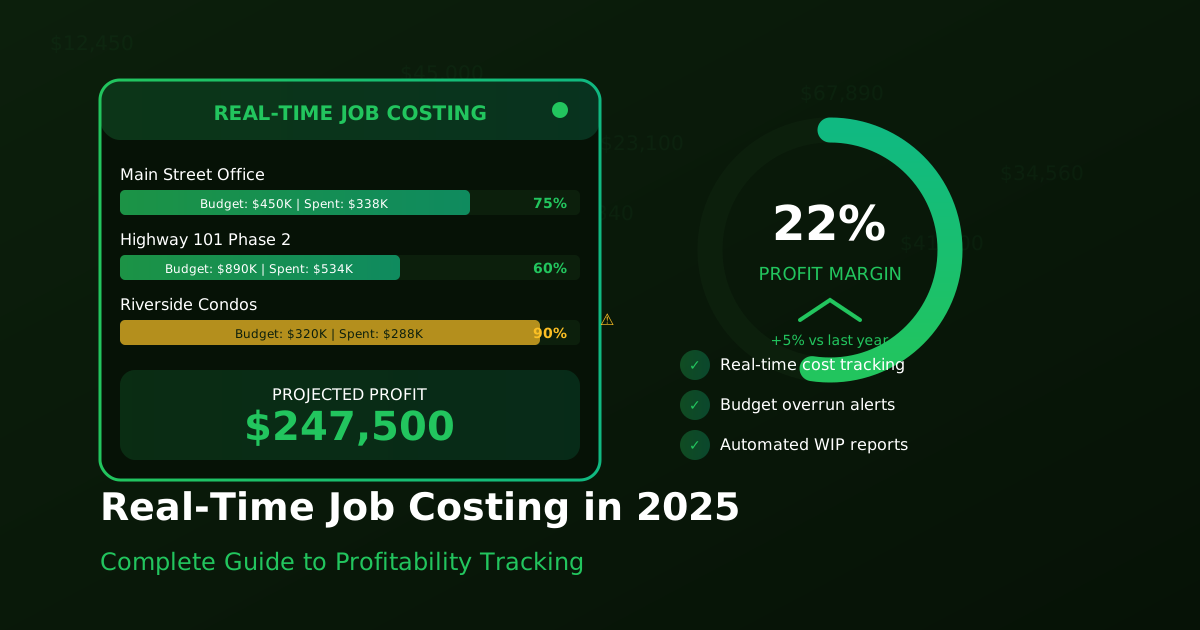
Variance Tracking: Every cost code shows budget vs. actual vs. remaining vs. forecast.
Earned Value Analysis: Comparing cost performance to schedule performance identifies true project health.
Forecast Updates: As actual costs come in, forecasts update to predict final project costs.
Intelligent Analysis
AI transforms raw data into actionable insights:
Automatic Variance Alerts: When a cost code trends toward overrun, you know immediately—not next month.
Pattern Recognition: Identifying which phases or cost types consistently vary from estimates, so you can improve future bids.
Productivity Analysis: Comparing labor hours to work completed, by crew, by phase, by project type.
Predictive Forecasting: Using historical patterns to predict final costs and flag projects at risk.
Implementation: Building a Real-Time System

Step 1: Define Your Cost Structure
Before implementing systems, define how you'll organize costs:
Phase Codes: How do you break down projects? Foundation, Framing, MEP, Interior, Site Work?
Cost Codes: What categories make sense for your work? Consider using CSI MasterFormat as a starting point.
Cost Types: At minimum: Labor, Material, Equipment, Subcontractor, Other. More detail enables better analysis.
Step 2: Integrate Data Sources
Identify where cost data originates and how to capture it:
Timekeeping: Mobile time tracking apps that capture job, phase, and cost code at clock-in.
Purchasing: Procurement system that requires job coding for every purchase.
Accounts Payable: Invoice processing that matches and codes automatically when possible.
Subcontract Management: Systems that track pay applications and link to project budgets.
Step 3: Establish Your Budget Baseline
Real-time costs are only meaningful compared to budget:
Transfer Estimates: Convert winning estimates into project budgets, maintaining the same cost structure.
Include Contingency: Budget contingency by phase or cost type, not just as a single line.
Update for Changes: As scope changes, update budgets to reflect current project scope.
Step 4: Create Review Rhythms
Data doesn't manage projects—people do. Establish regular reviews:
Daily: Superintendents review labor hours posted to their projects.
Weekly: Project managers review cost reports and investigate variances.
Monthly: Leadership reviews profitability across all active projects.
At Completion: Full job cost review and lessons learned for future estimating.
Step 5: Close the Loop to Estimating
The ultimate goal of job costing is better future estimates:
Historical Database: Maintain searchable records of actual costs by project type, phase, and cost code.
Variance Analysis: Document why estimates differed from actual—market conditions, scope changes, productivity issues.
Estimating Feedback: Update estimating standards based on actual performance data.
Common Mistakes to Avoid
Over-Engineering the System
Start simple and add complexity as needed. A basic system used consistently beats a sophisticated system ignored because it's too complicated.
Insufficient Granularity
"Labor" isn't specific enough. "Framing labor" is better. "Framing labor - wall framing" is better still. Match detail level to your need for analysis.
Delayed Data Entry
Real-time job costing requires real-time data. If costs are posted weeks late, you've lost the opportunity for timely intervention.
Missing Indirect Costs
Job costing should include appropriate overhead allocation. If direct costs look profitable but projects lose money after overhead, your system is incomplete.
Not Using the Data
The worst job costing failure is capturing data but not using it. Regular review and action based on cost information is essential.
The Competitive Advantage
Contractors with real-time job costing capability:
Bid More Accurately: Historical cost data improves estimate accuracy, winning work at sustainable margins.
Intervene Earlier: Seeing problems in real-time allows course correction before small overruns become big ones.
Negotiate Better: Detailed cost data supports change order pricing and dispute resolution.
Improve Continuously: Learning from every project compounds into significant capability improvement over time.
In an industry where margins are often single digits, the difference between 5% profitability and 8% profitability is transformative. Real-time job costing is how you find those percentage points.
Ready to implement real-time job costing? Explore our Accounting Agent for AI-powered cost tracking, or download our free Job Cost Tracker template to establish better cost monitoring today.