A Workforce Crisis Decades in the Making
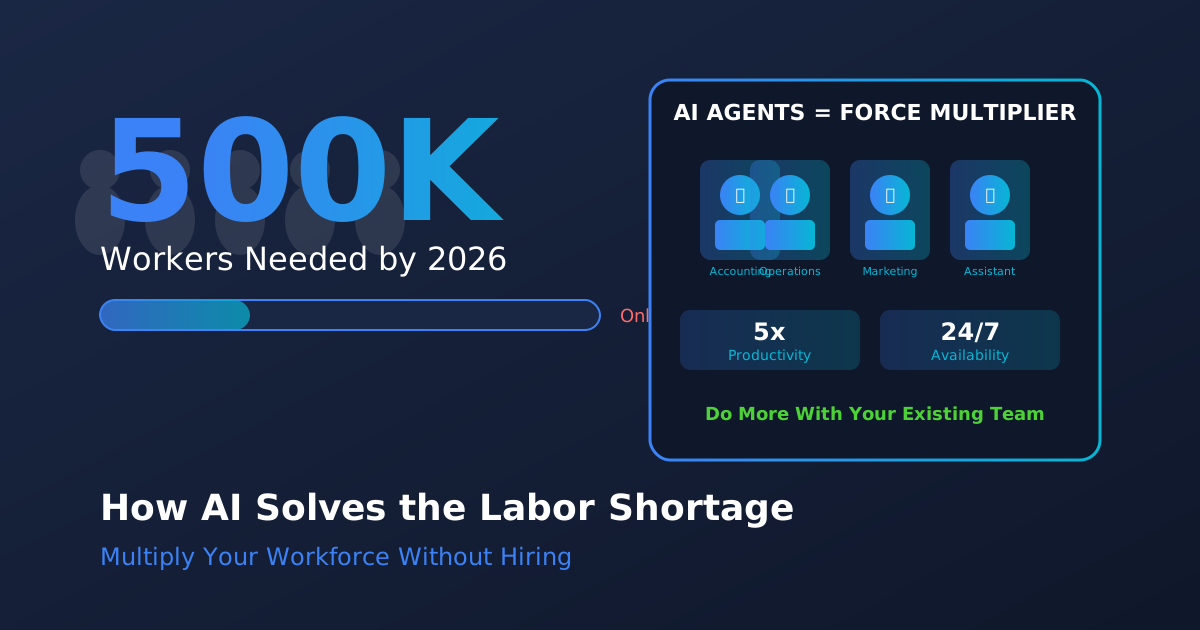
The numbers are stark. The construction industry needs 499,000 additional workers in 2026 alone just to meet current demand. Meanwhile, 41% of the existing workforce will retire by 2031. And young people aren't exactly lining up to replace them—construction trades remain consistently among the most difficult positions to fill.
This isn't a new problem. Industry leaders have been warning about the skilled labor shortage for years. But the gap is widening, not shrinking, and traditional solutions—higher wages, recruitment campaigns, training programs—aren't scaling fast enough.
Enter AI. Not to replace workers—that's neither practical nor desirable for most construction work—but to amplify what existing workers can accomplish. When every team member is supported by intelligent automation, the effective capacity of your workforce multiplies.
Understanding the Shortage
The Retirement Wave
Baby boomers dominated construction for decades. Now they're exiting in large numbers, taking irreplaceable knowledge with them. When a 35-year veteran superintendent retires, their expertise in managing complex projects, reading drawings, and anticipating problems doesn't transfer to a spreadsheet.
The Recruitment Gap
Younger generations aren't entering trades at replacement rates. Cultural bias toward college education, physically demanding work conditions, and misperceptions about career opportunities all contribute. The industry's traditional "pay your dues" culture doesn't appeal to workers with abundant alternatives.
The Skills Mismatch
Even when workers are available, they often lack the specific skills contractors need. Training takes time—time that's hard to find when you're already short-staffed.
The Productivity Problem
Construction productivity has been essentially flat for decades, while manufacturing and other industries have seen dramatic gains. The industry hasn't figured out how to do more with less.
Where AI Fills the Gap
AI doesn't put hammers in hands or pour concrete. But an enormous portion of construction work isn't physical labor—it's administration, coordination, documentation, and decision-making. That's where AI transforms workforce capacity.
Administrative Multiplication
Consider what your team spends time on beyond physical construction:
Back Office - Processing invoices and tracking payments - Managing payroll and compliance - Generating reports and analyzing data - Handling email and communication
Operations - Scheduling and resource allocation - Procurement and material management - Subcontractor coordination - Equipment tracking
Project Management - Creating and updating schedules - Preparing progress reports - Managing documentation - Tracking RFIs and submittals
AI agents can handle 60-80% of these tasks, freeing your existing staff for higher-value work. If your office manager currently supports 5 project managers, AI might enable them to support 10—without hiring anyone new.
Knowledge Preservation and Transfer
When experienced workers retire, their knowledge typically walks out the door. AI systems can capture and preserve institutional knowledge:
- Document standard processes and decision patterns
- Maintain searchable records of past projects
- Provide guidance to less experienced team members
- Ensure consistency regardless of who's handling a task
Decision Support
Less experienced workers can perform at higher levels with AI support:
- Real-time guidance on procedures and requirements
- Automatic checking of work against specifications
- Intelligent alerts when something seems wrong
- Access to historical data and best practices
This doesn't replace judgment and experience—it augments developing skills.
Communication Efficiency
Coordination across teams, trades, and projects consumes enormous amounts of time. AI streamlines communication by:
- Routing information to the right people automatically
- Summarizing long email threads and documents
- Sending reminders and follow-ups without human intervention
- Translating between technical and non-technical stakeholders
Real-World Capacity Expansion
Let's make this concrete with some scenarios:
The Two-Person Accounting Team
Before AI: Two accountants struggle to keep up with invoicing, job costing, and financial reporting for a $15 million contractor. They work overtime regularly and still fall behind during busy periods.
After AI: The same two accountants handle a $25 million operation comfortably. AI processes invoices, tracks job costs in real-time, and generates routine reports automatically. The accountants focus on analysis, compliance, and strategic financial management.
Effective capacity increase: 67%
The Overburdened Project Manager
Before AI: A PM manages three projects simultaneously, barely keeping up with documentation, scheduling updates, and subcontractor coordination. Quality suffers as they spread too thin.
After AI: The same PM successfully manages five projects. AI handles schedule updates based on field input, coordinates routine sub communications, generates progress reports, and flags issues requiring attention.
Effective capacity increase: 67%
The Growing Operations Team
Before AI: A 50-person contractor is reluctant to pursue larger projects because their operations infrastructure can't scale. Back office processes are manual and fragile.
After AI: The same contractor confidently takes on 30% more work volume. AI-automated procurement, scheduling, and documentation scale without proportional staff increases.
Effective capacity increase: 30%+ without hiring
Implementation: From Shortage to Sufficiency
Phase 1: Automate the Obvious
Start with tasks that are: - Highly repetitive - Rule-based (clear right/wrong) - Time-consuming relative to value - Currently causing bottlenecks
Typical starting points: invoice processing, routine report generation, schedule communications, document filing.
Phase 2: Augment Decision-Making
Once basic automation is running, add AI support for: - Job cost analysis and variance alerts - Schedule conflict detection - Resource optimization suggestions - Risk identification
These capabilities help your existing team make better decisions faster.
Phase 3: Capture Knowledge
As AI systems mature, focus on: - Documenting institutional knowledge - Creating decision-support frameworks - Building searchable knowledge bases - Establishing best practice libraries
This preserves expertise as experienced workers transition.
Phase 4: Continuous Optimization
AI systems improve with use. Invest in: - Regular review of AI performance - Feedback loops to improve accuracy - Expanding automation to new areas - Training team members on AI collaboration
Addressing Concerns
"AI will take jobs"
Actually, construction has jobs it can't fill. AI enables growth that creates more positions, not fewer. The contractor who can handle 30% more work hires more field workers, not fewer.
"My team won't adopt new technology"
AI tools designed for construction are increasingly intuitive. Many require minimal training. Start with tools that obviously make life easier—the team member grateful for automated invoice processing becomes an advocate for expanded AI use.
"We're too small for AI"
AI tools have become affordable at any scale. A 10-person contractor benefits from automated invoicing as much as a 100-person firm. Often more, since there's no dedicated staff for such tasks.
"Construction is too complex for AI"
Construction is complex—but much of the complexity is in coordination and information management, exactly where AI excels. Physical construction requires human judgment and skill; the paperwork surrounding it often doesn't.
The Strategic Imperative
The workforce shortage isn't going away. Waiting for labor markets to improve or training programs to produce more workers means years of constrained growth and competitive disadvantage.
Contractors who embrace AI-augmented operations will: - Grow despite labor constraints - Operate more profitably (doing more with existing staff) - Attract workers who want to use modern tools - Preserve and leverage institutional knowledge - Build more resilient organizations
The question isn't whether AI will transform construction operations. It's whether you'll lead that transformation or respond to competitors who did.
Ready to multiply your workforce capacity? Explore our full AI Agent suite built specifically for construction, or book a demo to see how automation addresses your specific constraints.